
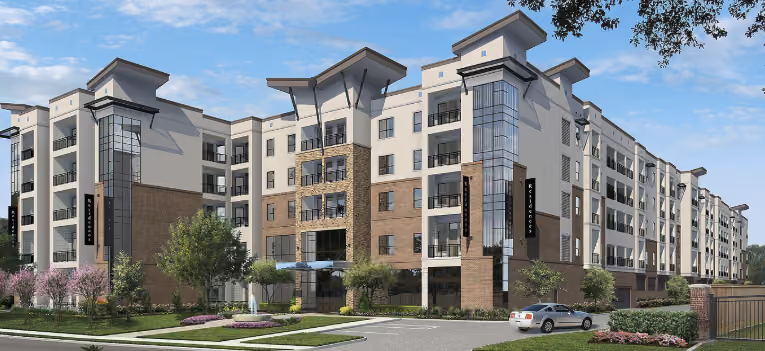
For years, capital has flowed into Houston’s inner core, transforming neighborhoods around the Texas Medical Center, Downtown, and the Museum District. Today, many of those submarkets are built out, expensive, or politically constrained. The search for the region’s next growth corridor is now turning toward Sunnyside, one of Houston’s oldest African American communities and, increasingly, one of its most strategically positioned.
Sunnyside offers a combination that has become rare inside Beltway 8: central proximity to employment, meaningful affordability, public-sector investment in infrastructure, and new amenities that fundamentally change the neighborhood’s value proposition. At the center of this story are two forces that matter to business and investment audiences.
First, the Sunnyside Redevelopment Authority and Tax Increment Reinvestment Zone 26 are deploying infrastructure dollars with a clear focus on catalyzing private development. Second, a new generation of amenities, anchored by the Hill at Sims regional park, is repositioning Sunnyside as a high amenity, high access neighborhood rather than an overlooked corner of the city.
In combination with a long-term rise in incomes and new housing activity, that makes Sunnyside a compelling location for workforce housing that serves the Texas Medical Center and the broader central city.
A Strategic Location for Employers and Working Households
Sunnyside sits just south of Downtown, between State Highway 288 and Martin Luther King Boulevard, outside the 610 Loop but inside Beltway 8. That geography matters. From Sunnyside, residents can typically reach the Texas Medical Center, one of the world’s largest medical complexes, in a short drive via 288, as well as Downtown, Midtown, the Museum District, and the University of Houston and Texas Southern University, through direct north–south corridors and regional transit connections.
Census-based travel data show an average commute time of about 18 minutes for Sunnyside residents, which is unusually short for a major metro, underscoring the community’s alignment with central employment nodes. For workforce housing investors, that translates into:
- Access to a large and diversified renter pool, including health care staff, educators, students, public sector workers, and service employees
- A story that institutional capital understands well: centrally located, historically underinvested neighborhoods, where public improvements and amenity upgrades unlock value
Fundamentals: Demographics and Housing Market Signal Opportunity
Recent data underscore the scale of Sunnyside’s workforce market:
- Population is around 18,000, with a year-over-year increase of roughly 5.5%, signaling renewed interest and household formation
- Median age is about 32, prime working and renting age
- Average household income is above $50,000 per year, with roughly two-thirds of residents living above the poverty line
The trajectory over the last two decades is even more telling. Median household income in Sunnyside has increased from roughly $20,000 in 2000 to nearly $28,000 by 2019, while the share of households earning $50,000 or more nearly doubled in that period. More recent American Community Survey estimates suggest further income growth since 2019, consistent with broader central Houston trends.
On the housing supply side, Sunnyside has:
- About 7,050 housing units, mostly detached single family homes, with a growing mix of small multifamily and mid-scale apartments
- A growing stock of newer product, including homes built after 2010 and a noticeable uptick from 2020 onward
- A majority renter population, with more than half of occupied units renter-occupied, directly supporting a workforce housing thesis
The Investor Edge: TIRZ 26 and the New Developer Reimbursement Policy
The structural advantage that sets Sunnyside apart from many other workforce neighborhoods is the presence of Tax Increment Reinvestment Zone 26 (TIRZ 26) and its active Sunnyside Redevelopment Authority. The city created TIRZ 26 to finance the construction of public infrastructure that would otherwise be a barrier to private investment, including new streets, utility improvements, drainage, parks, and related public facilities. Within that framework, the Authority has now adopted a Public Infrastructure Development Reimbursement Policy that directly targets the types of projects most attractive to institutional developers.
Key features that matter to business and investment audiences include:
- Reimbursement of eligible public improvements — developers may seek reimbursement for public infrastructure built in connection with their projects within the zone
- Performance-based capture of tax increment — TIRZ 26 can commit up to 50% of new tax increment generated by a project, after required city fees, toward the development agreement
- Focus on infrastructure and affordability — reimbursements are restricted to public infrastructure and affordable housing, aligning incentives with city policy and ESG expectations
- Structured, predictable process — developers submit budgets, financials, plans, and pro formas to the TIRZ 26 Projects and Planning Committee, with funds released only after work is completed and inspected
For capital partners, this structure reduces front-end risk by shifting a portion of infrastructure costs into reimbursable categories tied to actual performance, and anchors projects in a transparent framework—especially important as Houston tightens expectations for TIRZ governance and accountability.
Amenities as Value Drivers: The Hill at Sims
Modern renters and homebuyers, especially in the workforce segment, now expect amenity-rich neighborhoods rather than simply a roof at an attainable price. Sunnyside is moving into that category, with The Hill at Sims as the signature example: a planned 100-acre regional park on the site of a Harris County Flood Control detention basin along Sims Bayou and Scott Street, scheduled for completion around late 2025 and backed by approximately $28.3M in combined county, philanthropic, and state and federal funding.
Planned features include:
- A 1.6-mile basin loop trail and additional nature trails
- A hilltop pavilion and overlook with views toward Downtown Houston
- A 1.5-mile greenway along Scott Street connecting neighborhoods, schools, and churches to the park
- A new pedestrian and bicycle bridge across Sims Bayou connecting to the broader Sims Bayou Greenway system
Local and national park advocates are framing the project as an example of park equity. For developers and investors, the significant public capital invested in Hill at Sims elevates Sunnyside’s perceived quality of life and brand, supports active transportation and transit-linked demand, and signals long-term public commitment to the neighborhood’s transformation.
“Sunnyside now begins to look less like a peripheral neighborhood and more like a laboratory for equitable, sustainable urban redevelopment.”
Investment Thesis: Workforce Housing as the Bridge
Bringing these elements together, the case for workforce housing in Sunnyside rests on a few simple propositions:
- Demand is strong and growing — a renter majority, rising incomes, and working-age population create a ready market near major job centers
- Public investments derisk private capital — TIRZ-funded infrastructure and Hill at Sims improve flood resilience, mobility, and parks access
- The reimbursement policy can improve project economics — recapturing infrastructure costs can be the difference between a concept and a closed capital stack
- Room exists to set a quality benchmark — aging housing stock leaves space for first movers to set new design and amenity standards
What Forward-Looking Investors Should Watch Next
- Identify sites benefiting from Hill at Sims and Sims Bayou Greenway connectivity, especially along Scott Street
- Engage early with the Sunnyside Redevelopment Authority and TIRZ 26 committee to understand priority infrastructure and the reimbursement policy
- Structure projects that pair workforce housing with visible public benefits, strengthening the case for TIRZ participation
- Track delivery milestones for Hill at Sims and Sunnyside Energy, which will further validate the neighborhood thesis
Sunnyside has always been rooted in legacy. With TIRZ 26’s reimbursement policy, the Hill at Sims regional park, and a wave of new investment, it is now clearly poised for growth. For business and investment leaders looking for the next central Houston submarket where policy, infrastructure, and demographics align, Sunnyside deserves a hard look.
